Mt. Apo, Mindanao, Philippines
This may seem a prequel to the previous
blog that I posted, albeit with an even more fantastic twist, and a far larger scale at that.
Scenic Mt. Apo is the country's highest peak, majestically towering over the vast expanse of the southern tip of Mindanao island bordering over the mountainous edges of Davao City. However, the ancient narratives of an indigenous people that lived along its mountain ranges, the Bagobo tribe (they also named the peak, which means "grand old man"), bespeak about a fantastic claim that the names of ALL of Humanity's tribes supposedly originated from the foothills of this majestic peak!
Here is the Bagobo account:
Origin
Bagobo (Mindanao)
In the beginning there lived one man and one woman, Toglai and Toglibon. Their first children were a boy and a girl. When they were old enough, the boy and the girl went far away across the waters seeking a good place to live in. Nothing more was heard of them until their children, the Spaniards and Americans, came back. After the first boy and girl left, other children were born to the couple; but they all remained at Cibolan on Mount Apo with their parents, until Toglai and Toglibon died and became spirits. Soon after that there came a great drought which lasted for three years. All the waters dried up, so that there were no rivers, and no plants could live.
"Surely," said the people, "Manama is punishing us, and we must go elsewhere to find food and a place to dwell in."
So they started out. Two went in the direction of the sunset, carrying with them stones from Cibolan River. After a long journey they reached a place where were broad fields of cogon grass and an abundance of water, and there they made their home. Their children still live in that place and are called Magindanau, because of the stones which the couple carried when they left Cibolan.
Two children of Toglai and Toglibon went to the south, seeking a home, and they carried with them women's baskets (baraan). When they found a good spot, they settled down. Their descendants, still dwelling at that place, are called Baraan or Bilaan, because of the women's baskets.
So two by two the children of the first couple left the land of their birth. In the place where each settled a new people developed, and thus it came about that all the tribes in the world received their names from things that the people carried out of Cibolan, or from the places where they settled.
All the children left Mount Apo save two (a boy and a girl), whom hunger and thirst had made too weak to travel. One day when they were about to die the boy crawled out to the field to see if there was one living thing, and to his surprise he found a stalk of sugarcane growing lustily. He eagerly cut it, and enough water came out to refresh him and his sister until the rains came. Because of this, their children are called Bagobo.
http://www.pitt.edu/~dash/creation-phil.html#origin
The question may sound preposterous even from among locals here, furthermore exacerbated by mainstream education on history unwittingly patterned after previous colonial-based systems that will less likely hint of otherwise locally rooted but ancient phenomenon, having been very dependent on Western-biased sources and interests rather than that of the East or this country's.
Ridiculous it may seem to be, for how could "obscure" Mindanao from among more than seven thousand clusters of archipelago islands, in a country so miniscule to compare with other huge land masses and countries of this planet, would dare claim what could have been a very important role in the forgotten annals of Humanity's history?
Or so it seemed. Unless one puts the ace on the table; unless one considers this very ancient,
lost continent into the picture that existed, tens of thousands, hundreds of thousands, or even hundreds of millions of years ago, but forgotten or deliberately suppressed to a supposed "modern" but unknowing society.

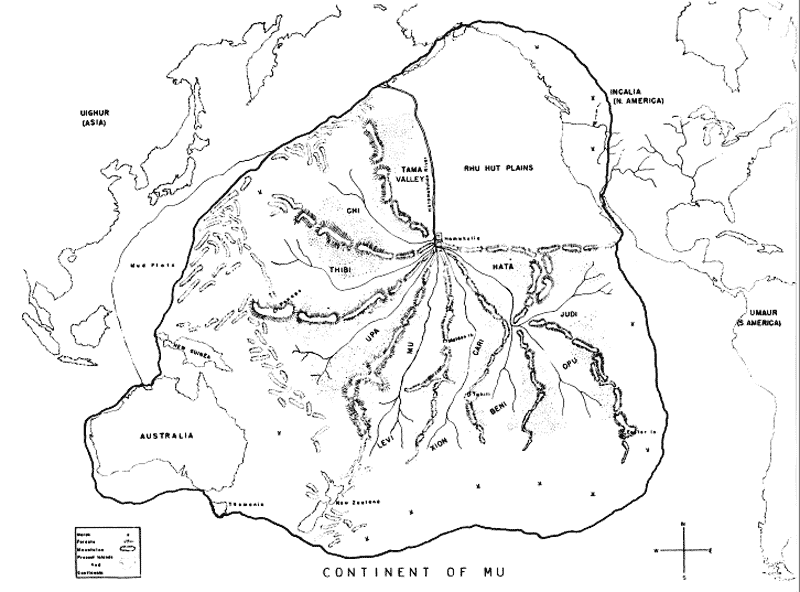
According to ancient narratives and documents, there once existed a very powerful continent known as the land of MU, or Lemuria. Much older than the West's legendary Atlantis or the Biblical garden of Eden, ancient Lemuria once stretched 5000 miles long and 3000 miles wide somewhere in the Pacific Ocean, with a population that was said to reach 63 Million people over 200,000 years ago. Its peoples were a noble, highly advanced civilization adept at telepathy, astral travel, teleportation, until its eventual demise, and based on my personal research, partly caused by alien interference (the Greek historian Plato, through Socrates, and another Mindanao indigenous tribe, the Bilaan also narrated accounts of the said phenomenon). The ancient ancestors of great civilizations of ancient Egypt (with more probability of later connection with Atlantis) and the Meso-Americas such as the Mayas, were even said to be refugees of this great, lost continent that may hold clue as to the similarities of Asians with American Indians and Eskimos. In the image provided, the sketch that featured the probable location of Lemuria showed that Mt. Apo in Mindanao that the Bagobo peoples claimed where the names of all the world's tribes originated may be on the edged part of the ancient legendary continent. It had been said that the eventual disintegration of Lemuria transpired over a period of many thousands of years, with the final destruction that occurred thousands of years before that of Atlantis (about 15,000 years or more).
The Bagobo mythology also predicted that the lost children will return back to their place of origin. As mentioned in my previous blog,
"Did the nation's ancient history originate from Southern Mindanao?", the early wave of settlers from Southeast Asia eventually arrived in Southern Mindanao about 500 AD, which through the years were followed by the arrival of other races from as far as Europe, America, and from other continents occurring even up to the present.


 Further evidence of the existence of MU also includes the strange, mysterious rock faces of Easter Islands, said to be remnants of the lost civilization of Lemuria.
  Notice the eerie similarity of these rock faces and other remnants to those found in the the submerged ancient city in Yonaguni, Japan and the stone ruins of American Indian cities! And should I also mention the seemingly similar physical features of Filipinos, Eskimos, and American Indian tribes?